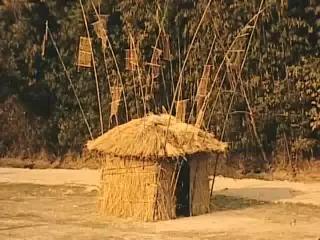
The Bodo’s the largest plain tribe live mainly in the Kokrajhar district of Northern Assam and belong to the Tibet Burmese mongoloid group. This Bodos calims to be the original inhabitants of ancient Assam known as Kamrupa. This News Magazine brings out the life & struggle of the Bodo people and their agitation for a separate state of bodyline.
Assam is famous for its malty flavoured tea. What is less is well known is that for 28 years a conflict has raged there between the Indian government and the United Liberation Front of Assam (ULFA). An estimated 18,000 people have died during the conflict. ULFA, the biggest of 30 different rebel groups, have been fighting for Assam's independence since the late seventies.
It is also home to 40 per cent of India's water, and 30 per cent of its oil. Many claim that the money made from these resources benefits the Indian federal government, but not Assam itself. Since the Indian army took up residence in 1989, ULFA have been fighting for an independent Assam, and with it, control of its natural resources.
A writer looks for a bit of good news in the days of the Assam Movement (1985-90), when the youth had sunk to the lowest depths of degradation, and civilized emotions seemed to be wiped completely out of existence. Everywhere prevailed only lust and cowardly violence. Newspapers had chilling pages of depressing stories and to read them was to be overcome by an even greater feeling of horror and helplessness. Finally the writer discovers a small piece of news item in a morning paper that gives him hope as it brings him tales of inspiring people who survive the troubled times by piously and devoutly reading their holy scriptures.
People who resides at the border between India and Bangladesh found themselves in a state of lost when construction of fence started along the border. Some of the field of cultivation of the citizens of India are in Bangladesh. Now they find difficult to cross over to cultivate in their own land. Security are tight from both side, that is theri everyday nightmares.
British and Indian forces have been fighting the Japanese at Imphal on the Burmese border for many weeks. The Japanese are now in retreat having suffered many casualties.
on 15th August, India celebrates its independence, on the same day, groups fighting for independence from India, call a protest shut down of North Eastern India….
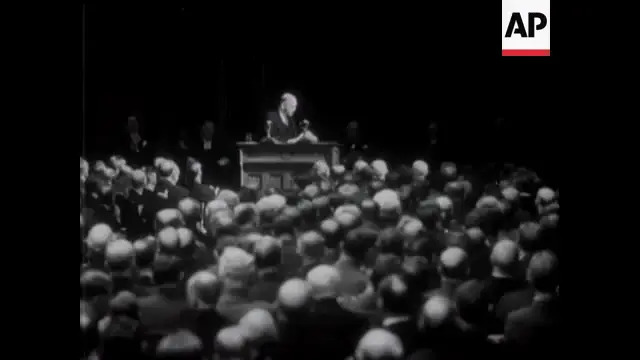
(18 Jun 1980) Speaking "underground" to avoid arrest, the President of ASSU (All Assam Students' Union) Mr Prafullah Kumar Mohanta answers questions on how he would describe a "foreigner" and how he would answer charges that his movement is an act of secession and communalism. He is accompanied at the interview by Mr Neelam Barua, a post-graduate student and secretary of the Debate and Symposia.
People in Meghalaya bet on Archery. It is known as Thoh Tim, or Teer (arrow), or Siat Khnam (Shoot Arrow). Is it a gambling? Or Is it legal? In this short Documentary it explains this queries.
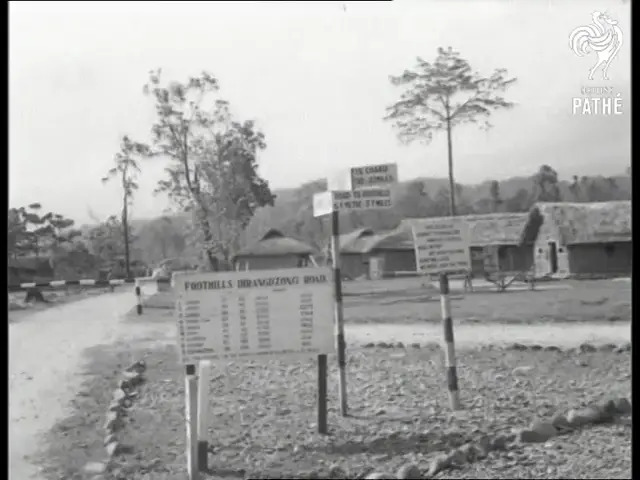
Various shots signs on the foothills. MS sign on the foothills. Various shots of the Army Base Camp of Kameng Frontier range. Check Post with barrier in the middle (the road beyond the barrier leads to Bomdilla where Dalai Lama would first arrive and then move down from there to Tezpur). Barrier being lowered. CU thick jungle surrounding the area. CU of sign hanging from a tree indicating prohibited area. LS of the road leading to Nefa Area. Various shots of army personnel clearing the roads of fallen trees. Various shots soldiers cutting trees to remove them from the road. Two shots of elephant carrying tree branches to be used on temporary roads for the arrival of the Dalai Lama. People buying vegetables in market place. Various shots of the market with tribesmen and women squatting on floor displaying their articles for sale, woman weighing on scales, group of women arriving with baskets tied on their back, shots of market purchasing. Date on dope sheet is 11/12th April 1959.
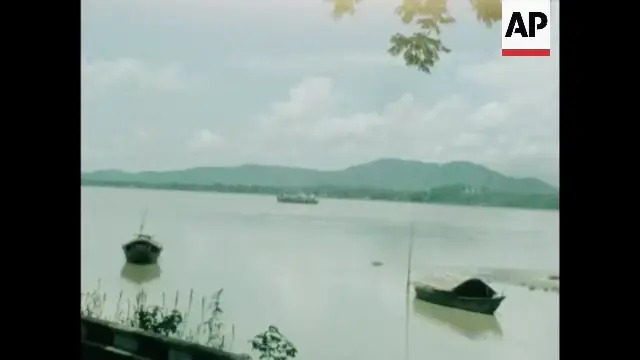
Glorious colour film of a fishing trip and geese-hunting expedition in north-eastern India. G. Mackrell was a tea planter and big game hunter who lived in India from the mid-1930s to the late-1950s with his wife, R.S. Mackrell. His amateur films provide some of the clearest records of the adventurous life that many British entrepreneurs and military personnel forged for themselves in India prior to Independence. This glorious colour film records a fishing trip by canoe down the Barak River in north-eastern India, and a geese-shooting expedition, which prove extremely fruitful judging by the array of catch the Mackrell party and local fishermen are seen posing for the camera with. During WWII, Mackrell was also involved in rescuing refugees fleeing Upper Burma before the Japanese advance.
Ethnographic feature film following two headhunters of the Naga tribes in north-eastern India. Part ethnographic film, part narrative feature, Nyimsao and Kheseto follows two men of the Naga people, living in a village in the hills above Assam in the far north-east of India. With origins in Yunnan (China) and Burma, the Naga tribes had their own dialect, and customs included headhunting - filmmaker Charles Suydam Cutting had joined a party sent by the local British district commissioner to stamp out this practice. Headhunting was finally banned in the region in 1991.
On the 15th of August 1985, these words of Rajiv Gandhi seemingly brought to an end one of the longest agitations in Assam. An agitation which claimed hundreds of lives and had brought the economic growth of the state to a standstill but signing of the Assam Accord a new beginning was promised the Accord address itself to the principal issues of contention the infiltration of foreigners in Assam the economic package for all round development and the protection of Assamese culture and tradition. The effort then began to identify the foreigners as per the conditions agreed to in the Accord. Those who immigrated prior to 1996 were to be given Indian citizenship. Immigrants who came into Assam between 1966 and 1971 were to be disenfranchised for 10 years. Those arriving after 1971 were to be deported. The 1985 elections saw the agitation leaders become the new political masters of Assam. It was from this campus of Guwahati University a young band of student leaders has marshal their forces and mobilize the people's movement to challenge the government and paralyze administration. Now, these leaders were the cabinet ministers of Assam Gana Parishad Movement. This footage is part of the broadcast stock footage archive of Wilderness Films India Ltd., the largest collection of HD imagery from South Asia. The collection comprises of 150, 000+ hours of high quality broadcast imagery, mostly shot on 4K, 200 fps slow motion, Full HD, HDCAM 1080i High Definition, Alexa and XDCAM. Write to us for licensing this footage on a broadcast format, for use in your production! We are happy to be commissioned to film for you or else provide you with broadcast crewing and production solutions across South Asia. We pride ourselves in bringing the best of India and South Asia to the world... Please subscribe to our channel wildfilmsindia on Youtube www.youtube.com/wildfilmsindia for a steady stream of videos from across India. Also, visit and enjoy your journey across India at www.clipahoy.com , India's first video-based social networking experience.
Part of India on Film: 1899 – 1947 Excerpt from "Aka and Daffla Dances (1934)" Dancers from the Dafla (Daphla) tribe perform spectacular tight-rope tricks, and act out a ritualised hunt with masks.
For the Khasis, traditional archery is not only about marksmanship of the archers but also about their spiritual and psychological prowess What makes the sport special is the elaborate prelude to the archery-invoking the blessings of Ka Mei Hukum or the Mother Teacher who apparently teaches her worshippers from within, setting up of covenants or terms of challenge between two teams, arguing over these covenants and finally submitting the arguments to Ka-Mei-Hukum for her judgment.The locals believe that unless a player has the blessings of the Mother, he cannot win even if he is an excellent marksman. At the end of a game, it is entertaining to watch the winning team sing a victory song mocking the opponent
This film is a study on the relationship between the tribals and the bamboo as a relationship from birth to death. It investigates further into the flowering of bamboo in Manipur and Mizoram which has got environmental, economic and political dimensions.
The film is about the famous music teacher in Shillong since late 1980s Bah Richard Nongrum. Students from around Shillong throng to his School of music to learn the art of music and try to copy his mesmerizing tune.
This archival documentation from the Sangeet Natak Akademi filmed on location since 1956 glimpses the tapestry of the folk and tribal dances of North-east India. Compiled by Susmit Bose in 1999.
a Sacred grove or Law Kyntang has stood for at least 1000 years and one of the reasons the forest still survives is because cutting down any tree or branch here is taboo. This forest is the home of U Ryngkew U Basa. The forest covers almost 80 hectares. It is under the Kingdom or Hima Mawphlang, in which here they perform various thanksgiving and blessing ceremoies. Some of the this rituals go back to 900 years old.
Ambi Jiji always planted her crops on soil where forests have been burnt. This jhum field would then be abandoned and left to regenerate into a forest and a new one burnt. Increasingly, jhum fields are being turned into orchards which provide cash and food security. Through Ambi Jiji and her daughters, we see the passing of a way of life in a remote village in Meghalaya.